Forecasting wildfires for 2021 CA based on chamise water retention

Hailing from Redding, CA, I’ve seen my fair share of wildfires. Once, in high school, while late night swimming at Whiskeytown Lake, some friends and I beat out a fire with our towels alongside highway 299. A car speeding by saw us on the roadside, hit the brakes, and sparks flew everywhere, lighting the roadside scrub in an instant and immediately beginning to spread. Scary stuff.

As bad as the last few years have been for wildfires, it looks like this year is shaping up to be apocalyptic. Wired has an article talking about chamise and how the chaparral scrub is being used to measure the ambient water retention in these dry areas. TL;DR, it’s not looking so great:

And nothing scares a fire weather scientist quite like a year with dehydrated chamise. If it’s dry, then that’s a good indicator that everything is dry. “Right now, these are the lowest April 1 fuel moistures we’ve ever had,” Clements says. This is supposed to be the time of year when moisture levels are at their highest, thanks to recent autumn and winter rains. But California is withering in a drought. […] The California landscape appears ready to burn epically this year.

The Humble Shrub That’s Predicting a Terrible Fire Season, Matt Simon, Wired

So let’s check back on this one. I’ve put a reminder to check-in in the CA situation in November 2021 (hopefully post fire season) this year to see how accurate this forecast is.

Bitcoin and Crypto Investing (some initial thoughts)

I started learning about investing when I joined Amazon in the late 90’s and couldn’t stop staring at each day’s ticker. What did all that movement mean? Why was the stock splitting all the time: How were investors evaluating the company? Was I going to be a fabulously wealthy customer service rep (spoiler alert: only those who joined literally several months prior to me and before got that privilege thanks to the timing of the e-commerce bubble pop). Fast forward 22 years and I now run an investment advisory and have created valuable frameworks that I use to invest on behalf of myself and others.

And now, Bitcoin. A few years back when I took a small position, I spent time reading about it (and all blockchain technology), listening to podcasts, and just generally attempting to educate myself. There’s nothing like skin in the game to keep your interest high, so I took a very small position in 2017 and just watched it.

And then this year in May, even though I can’t say I full understand Bitcoin and the other various major cryptos, I decided to purchase an “option call on the future” by purchasing shares of the private Bitwise 10 Crypto Index Fund, using some money from my self-directed IRA. As of tonight, that stake is up 175%. While it would be nice to claim brilliance and keen insight, I clearly do not have a handle on the space yet.

Even though I’m a long way from being a Bitcoin bull, and I have yet to recommend it to any of my advising clients, I do find most of the arguments against Bitcoin to be moronic and largely addressed answered by reading the first few paragraphs of the original Bitcoin White Paper.

Based on what I see, my hope for Bitcoin is that it starts to roll up more and more transactional value, working up from the least credible and highly volatile fiat currencies to the most trusted and most stable over time. You might have trust in the full faith and credit of the US government, but that doesn’t mean your home bias should apply to the rest of the world’s population. Citizens of Venezuela and Greece, for example, may have a very different tolerance for their currencies than you do. Trust in the USD is not universal and probably not deserved.

My guess is that we’ll see Bitcoin transfers happening across borders at a much larger scale ahead of it being used to purchase daily groceries. The price of Bitcoin is stable enough to transfer funds and convert it into a local currency that can be spent. I would take the uncertainty of that principal changing between point a and point b, over the certainty of feeding financial intermediaries like Western Union or banks.

My strategy, until I learn more, is this. Take a percentage of my assets I am comfortable learning with, find a way of covering as many of my blind spots as possible (hence the cap-weighted index from Bitwise), and let it go. I don’t have to understand everything to understand the asymmetry present if any of these large crypto projects get real traction and adoption globally.

Staying the course can be the “best idea”

Your best ideas should be somewhat durable. When I first read David Heinemeier Hansson’s “Work on your best idea” post, it felt like a clarion call to get off my ass and do something new. Surely there must be a large gap between where you need to be, today, and where you are? Right? Wrong. While not every day provides the Bacchanalian pleasures I dream about, they are situated within a risk/reward framework that I have created for myself. I have made commitments for my family, my employer, and my friends. While many of those commitments are mundane and repetitive, they are constraints I gladly accept. Sometimes the truly valuable work is a continuation of what you’re doing, and while it’s not sexy to say it that way, I think that’s a valid interpretation of the post too.

Weekend Provocations

Kevin Kelly is a god-damned treasure: I started highlighting my favorites and the whole page was going yellow.

Separate the processes of creation from improving. You can’t write and edit, or sculpt and polish, or make and analyze at the same time. If you do, the editor stops the creator. While you invent, don’t select. While you sketch, don’t inspect. While you write the first draft, don’t reflect. At the start, the creator mind must be unleashed from judgement.

Kevin Kelly, 68 bits of Unsolicited Advice

COVID-19 – the return of Wave 1: It appears nearly certain that the US is opening back up for business without heeding the guidance from leading scientists at the CDC. I’m trying to figure out what that will likely mean for my family and business, but I expect it’s not a positive…

Organized crime in antiquities: It’s shocking to me that a criminal enterprise of this scale, trading in rare and precious artifacts, can be disrupted with 19,000 archeological artifacts recovered. How long have these networks been in place and how many artifacts have they stolen from the enjoyment of broader society?

Bitcoin buffoons: The worst part about investing in Bitcoin (I have a small position) is being lumped in with the rest of the Bitcoiners. Do a search on Twitter for Bitcoin and sample the livestream of poorly reasoned (and frequently poorly spelled) drivel that is there. I’m hopeful that the silent major holders are a more cerebral lot. 

“Happy thoughts” recommendation: If you’d like a little creative multi-media inspiration each week, I enjoy Austin Kleon’s newsletter (sign up here). He’s frequently a twisty trip down random memory lane.

The value of painting yourself into a corner

Years ago, when I ran The Puget News (RIP), a friend of mine I hadn’t seen in a while, gave me a wonderful compliment during a conversation we were having. He said something to the effect of, “You’ve been writing a lot recently, haven’t you? It shows. You’re speaking beautifully and gushing with ideas.” His words were spoken without a hint of irony and is something I think about quite often, not just because it was a gracious thing to say, but because there are so many times that I struggle to articulate a coherent thought.

Building a place on the internet to call home and then writing to a schedule is a challenge, but one worthy of throwing yourself against. It’s especially worthwhile if your goal isn’t notoriety, but clarity of thought.

One of the personal principles I try to live by is: “if you can’t write it or draw it, you don’t know it.” While it won’t always be pretty, this place is my attempt to live by that principle.

Weekly Recommendation Roundup – Things that make you go, hmmm

Books

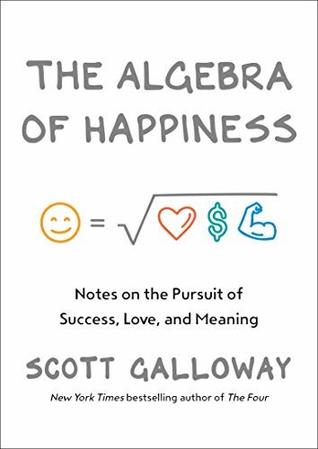
Algebra of Happiness, by Scott Galloway

This is the type of book we should all strive to write and leave to our children, it’s a highly personal distillation of Galloway’s life experiences for his students at NYU (and more importantly, his own children). If you do not like his self-absorbed presentation in his other mediums, you probably won’t like this either, but I find Scott entertaining, pithy, and refreshing in his directness. Chock full of things I wish I knew when I was 20.

Web

The Case for First-Brain Memory, by Tasshin

This post is a refreshingly through investigation of when it makes sense to memorize something, and when it doesn’t. I was blown away watching LeBron James recall a particular a series of plays after a game. It goes to show you that world-class athleticism is never purely physical.

Podcasts

The Portal: 3: Werner Herzog

The Portal is one of my new favorites for in-depth long-form interviews with people that have truly unique viewpoints on the world. The first three episodes all contain dangerous thoughts and mental models, but this one with Werner Herzog sparked my curiosity so much that I paid a transcription service to provide me the text. I knew very little about Werner Herzog prior to this interview, but he’s clearly one of the most creative forces in film. To hear him describe the challenges that he and his artists endure is a testament to uncompromising vision.

I first became aware of Werner Herzog when I was 16 and just entering the University of Pennsylvania and a friend of mine said, ‘You’ve got to see this movie, Fitzcarraldo.’

‘I said, what is Fitzcarraldo?’

He says, ‘if nothing else, it’s a story about a man so possessed by an idée fixe, that he drags a boat over a mountain in the jungle in order to somehow build an opera house.’ The whole thing sounded incredibly mad, and in fact, what was so interesting about this film was that the director actually had to do, in real life, with the crazy fictional character did inside of the story line.

Eric Weinstein

Movie

Fitzcarraldo, by Werner Herzog

You can’t listen to the podcast recommended above and NOT immediately want to go see this movie. The imagery and vision are haunting me weeks later—as do the ethical questions that the making of the money engender. I’m definitely going to be following up with the “making of” film.

Quote I’m thinking about…

Join my new movement—The Spongy Front

As long as he fought imaginary giants, Don Quixote was just play-acting. However once he actually kills someone, he will cling to his fantasies for all he is worth, because only they give meaning to his tragic misdeed. Paradoxically, the more sacrifices we make for an imaginary story, the more tenaciously we hold on to it, because we desperately want to give meaning to these sacrifices and to the suffering we have caused.

Yuval Noah Harari, “Homo Deus”

Can we agree that it’s one thing to be anti-fascist and another to be Antifa? or Iron Front? There’s been a bit of a firestorm in the Pacific Northwest due to our local MLS supporter clubs in Portland and Seattle flying the Iron Front flag at games. In Seattle, representatives of the team compounded the problem by initially ham-fisting their request not to use the symbol — equating it politically to Proud Boys and Patriot Prayer.

Oops. That argument lacked a little…nuance.

Now I’m no fan of the Proud Boys and Patriot Prayer. In fact, you could call me “anti-” those things and I’d be fine with it; but I think it’s perfectly justifiable to also be uncomfortable with the adoption of symbols and tactics from historical paramilitary groups (e.g. Iron Front). These symbols have power because they pull from complicated legacies that are impossible. Nobody today has the full context of that symbol and group, and everyone reads into it with their own self-righteous response.

My personal belief is that heightening direct opposition to groups like the Proud Boys creates a sense of legitimacy for them and increases its appeal. These guys are trying to stand out and to draw a response—successfully as it turns out. The way to defuse the situation is to NOT draw attention to it and treat them as you would anybody else—have a pint, listen with compassion, and call out their BS as if they were a crazy family member you HAVE TO TOLERATE. They have to find out that there is nobody to fight, nobody windmill to tilt at; they’re just…wrong.