Special places

When I was a literature major at UCSC, I liked to get up early, go surfing for an hour when the swell was reasonable, and then head up to campus and read at the Kresge Study Center on campus. Most of the time I was the first person into that study room. I’d kick on the heater and pull up a big reading chair next to large panels of glass facing right into a wooded ravine. Many mornings, there’d be mist obscuring the view beyond the first few trees. This would make it easy to lose yourself in whatever I was reading that week. As a literature major, that was always something new.

I’ve been looking for a good photo of that room as it’s been 25+ years since I’ve been there. Unfortunately, all I have found so far is this uninspiring photo from the campus website.

This photo completely fails to do the room justice (although the tie dye does seem spot-on). It looks like it’s been renovated and not necessarily in a way that heightens the natural attributes. Clearly, digital cameras weren’t a thing when I was going to school at UCSC, but I would love an image shot from my reading chair in that room where I’d sit there alone to start the day.

Do you have a special place? One that’s important to you but you haven’t seen in a while?

Twitter bye-bye

I would not have believed so much damage could be done in so little time.

Several years ago, I left Facebook and deleted all of my history on the site. That departure was the results of years of poor interactions and/or discoveries, largely from people I know. Deleting my profile and removing myself forever has been a positive experience.

Twitter, on the other hand, is something I have lovingly curated and really enjoyed until very recently. It’s a beautiful hub for the finance industry, in particular, and I have lists of important people that I read for investment and business insights. Not anymore. I removed the app on my phone and tablet. I removed the Twitter link from my business’s website. I’m not deleting my accounts because I think there’s still hope, and I don’t want my Twitter handles to go to any poachers, but I’m done for a while.

It’s clear that Elon has no idea how to manage a social site. Not content to leave well enough and learn, he’s been dedicated to rapidly (sometimes intra-day) implementation of diametrically opposed policies. The policies only make sense when you realize Elon’s creating permissions for people he agrees with and removing permissions for people who disagree with him. Elon’s policy is that “the policy is what I say it is.”

I hope to be back when things stabilize. Until then, I’m going to explore all other alternatives and watch where the smart folks land.

Thoughts on the World Cup Final 2022

Looking at the aesthetics of the match, France had no business winning; and yet, there they were, in it until the penalty kicks. Argentina owned the entire first half. They were the aggressors, the only ones able to build flow, the only ones able to attack. Di Maria was man possessed on the left side for Argentina, creating space and opportunity reliably in the final third form the left. He was taken down in the box for the first penalty and scored the second Argentina goal on a beautiful run of play a few minutes later.

Most of normal time in the game was fairly routine and boring. France was absolutely unable to get anything going or to find Mbappé with any space to make anything happen. For 80 minutes, it was all Argentina. A masterful game plan that was crushing France’s spirit and leading to an inevitable (and disappointing) overall match for France (but hey, at least Messi was going to get his win and the Golden Boot, right?

But then it all chnaged. France got back into the game on a penalty kick in the 80th minute, followed by an absolute scorcher by Mbappé from the left side of the box 1 minute later. I think it was 90 seconds or less of elapsed clock time that had France tying it and then playing to take the team into extra time. Wild.

Again, in extra time, Argentina is the only one that created a real shot that went in. IMO, Messi deserves the Golden Boot for that shot. He won’t get it because Mbappé was able to sit over yet another penalty kick several minutes later to tie it. Another goal he did not deserve or create, but that he did put away.

Messi gets the legacy he deserves. He played with passion and spirit. I’m happy he got this. For me Di Maria, despite being pulled off in the second half, is the man of the match. Absolutely incredible attacking from the left.

2022: My Year in Books

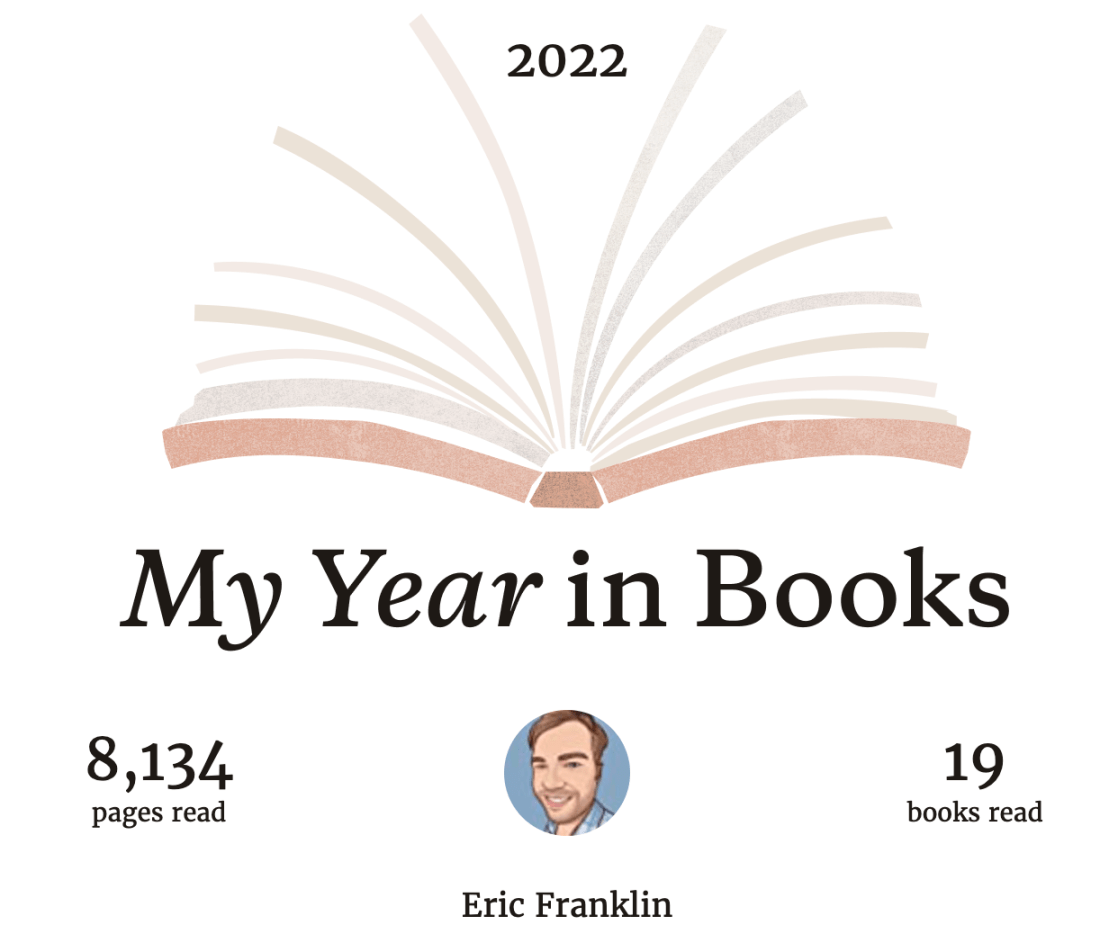
I love this feature from Goodreads. 2022 looks to be the year I finished the fewest books in a long time, but I’m pleased with the quality of what I read, and think that the dense nearly 3k page monster from Dr. Iain McGilchrist can be at least partially held responsible for the lower than normal count. That one took several months of late-night reading sessions.

3 surprises on the up-side in 2022 are:

  • “Something To Do with Paying Attention,” by David Foster Wallace – If you told me I’d be reading a portion of a larger unfinished work (this is a portion of “The Pale King”), that the subject matter was. young man going into the IRS, and that this would somehow turn out to be a tale of everyday heroism, I think I would have stronly doubted you. This novella is a perfect little jewel though. I loved it.
  • “The Matter With Things,” by Dr. Iain McGilchrist. This is a masterwork on a level that is hard to explain. IIRC, the first several hundred pages are literally just catalogs of scientific findings that build the basis for what comes later. When this moves on to the large philosophical work, it is jaw-droppingly insightful. It’s intimidating to think about re-reading this one, but I need to go back through and do a better job of extracting and organizing the insights. It will happen. Probably not in 2023.
  • “The Ministry for the Future,” by Kim Stanley Robinson. Why is this one on my surprise list? Everyone said it was good, right? It’s a surprise for me because I have read Kim Stanley Robinson several times before and never fully enjoyed the experience. While I appreciate the scope and detail of his thinking, I have found the plots too calculated and lacking humanity. While this book doesn’t necessarily solve for those issues, I loved the passion with which Robinson goes after climate change and think the scale of his thinking is exactly what we need to spark conversation about actual solutions to our presence here.

On the downside, these are books I will not be recommending:

  • ” A Place of my Own,” by Michael Pollan. “How to Change Your Mind” is one of my favorite books of the last several years so I was hoping to find something as enlightening and engrossing here. I did not. Architecture enamors me, but this book felt like I was reading a tedious journal of carpentry.
  • ” A Heartbreaking Work of Staggering Genius,” by David Eggers. It’s clear that Eggers understands the faults of this book work as he calls them out explicitly in the foreword. I think you should follow his advice and only read the entry novella. Once he moves to the Bay Area, it’s over-the-top treatment of self as protagonist is really hard to enjoy.

The Trouble With Goals

Goals are binary. They create an expectation, not just of completion, but of reward. Rarely do these align with anticipation.

Instead, goals are for focusing your now. This moment.

If you can learn from this moment and realign to fit your learnings, you’ll end up somewhere unexpected, but usually far better than where you were trying to go.

Jony Ive’s first project at LoveFrom ◙

From Fast Company:

I didn’t see this when it was announced last year, but the logo and typeface for an environmental project “spearheaded by Prince Charles” is absolutely lovely in every way and miles apart from the sleek industrial look that Ive is famous for.

To design LoveFrom Serif, Ive’s team studied original Baskerville punches and matrices. They analyzed the shapes and cleaned them up into digital characters. From there, the team began making Baskerville their own, adding details inspired by other lettering work of the era.

https://www.fastcompany.com/90693444/jony-ives-first-major-design-since-leaving-apple-isnt-what-youd-expect

I’m excited to see what Ive and his new company do next!

The Download: Ukraine claims it’s using facial recognition to identify dead Russian soldiers ◙

Mykhailo Fedorov, vice prime minister of Ukraine and minister of digital transformation, confirmed that Ukraine was using facial recognition software to find the social media accounts of deceased Russian soldiers, allowing authorities to contact their friends and families. The aim is to dispel misinformation surrounding the war in the country, and specifically Russian claims that it is just a special operation with few losses, he wrote on his Telegram channel.

https://www.technologyreview.com/2022/03/24/1048268/the-download-ukraine-claims-its-using-facial-recognition-to-identify-dead-russian-soldiers/

Yeesh. A new tool in psychological warfare: snuff shots sent to family members. Russian media may not produce real coverage of their unjust war (and is only reporting 498 deaths so far) but you can bet that Ukraine informing families via social media of their missing lived ones will not be easily swept under the rug. NATO estimates “40,000 Russian troops killed, wounded, taken prisoner, or gone missing.”

There are other ways of doing things…

I loved this Nilay Patel interview of Matt Mullenweg, CEO of Automattic (and thereby WordPress, Tumblr, and WooCommerce; as well as the maker of high quality apps like Simplenote, Pocket Casts, and Day One).

I had no idea how prevalent WordPress has become.

WordPress in the CMS space now has 43% of all websites. It’s growing faster than all the others combined. That will reach probably 80–85% in the next decade.

Matt Mullenweg, How WordPress and Tumblr Are Keeping the Internet Weird

43%! In the interview, Matt talks about a potential market share of 85% within the next decade. He could be wrong, but his directional velocity is probably right. That’s incredible. What’s even greater than that, in my opinion, is how he’s scaling the company ethically. You can see the responsibility he feels for monetizing the right way and empowering distributed decision-making across the entire organization.

Most of our business models are through people paying us, as opposed to advertising or other models. We provide upgrades and that recurring revenue is what allows us to come to work the next day. We’re about to come up on 2,000 people working full time with Automattic. It’s really grown a lot, even since the last time we talked. I think we hired over 700 last year.

Matt Mullenweg, How WordPress and Tumblr Are Keeping the Internet Weird

The other fun thing I like to say about Automattic is that it’s fractal. When you zoom in or out, it’s self-similar. When the entire company was 20 people, it looked a lot like what a team of 20 people looks like now. We try to make it so there’s a natural growth and division of teams.

Matt Mullenweg, How WordPress and Tumblr Are Keeping the Internet Weird

The final bit I wanted to call out and record for posterity, because it’s novel and aligns with how I think distributed companies should be run, is this bit:

I ask for transparency, so that things are written down, shared, communicated. I love the idea of decision journals. We use this internal blogging system built on WordPress called P2. […] What’s interesting at Automattic is there’s no internal email. I get a handful of emails a year from my colleagues. Everything happens on these internal blogs. What that means is we have essentially an organizational blockchain where every single decision going back to 2007 is on one of these internal blogs. You can find how every piece of code works, or every business decision, or every logo. Everything is in there somewhere.“WE HAVE ESSENTIALLY AN ORGANIZATIONAL BLOCKCHAIN WHERE EVERY SINGLE DECISION GOING BACK TO 2007 IS ON ONE OF THESE INTERNAL BLOGS.“

Even if you and I decided something in a meeting, we need to write it up afterwards. It’s on this P2, so people can participate in it asynchronously. Future generations or future versions of ourselves who’ve forgotten why we made a decision can tell why we did that.

Matt Mullenweg, How WordPress and Tumblr Are Keeping the Internet Weird

Nothing is done until it is written up and recorded. This has always been an aspirational goal of mine, even when it is out of alignment with how my employers worked. Now that I run my own company, though, I get to do it how I want.

Francis Coppola: The creative process behind “The Godfather”

“The Godfather” (movie) stands the test of time as a work of art because of the hard work that Coppola put into the details of translating the literary work into cinema. When you think about the director lugging this notebook with him everywhere on set and using it as the singular resource for coordinating actors, production crew, etc. you get a sense of how he was able to maintain an understanding of where “true north” was at all times.

Key takeaways:

  1. Record impressions as you have them. You only read the book for the first time, once.
  2. Go deeper. In this case, Coppola was pressure-testing the text against the cinematic context. Figuring out what worked, what would be challenging, what could be dropped.
  3. Make your learning visual. Coppola was careful to preserve the underlying text by expanding the margins, using a ruler to point to passages, and then through utilization of symbols (such as asterisks) for emphasis.
  4. Synthesize, synthesize, synthesize. After understanding the text in great detail, creating a library of things he thought could work, and chunking the book into scenes of his own devising, ONLY THEN did he start mapping the scenes and elements so that they would work on screen. His notes about pacing, character development, synopses, etc. come after a meticulous exculpation of the underlying work.
Francis Coppola’s Notebook on ‘The Godfather’

Followup: Found another, even more detailed look at this notebook.