

Dated in a way I did not really enjoy. Self-aware in self-adulating way I also did not enjoy.
Dated in a way I did not really enjoy. Self-aware in self-adulating way I also did not enjoy.

Way more funny than I would have expected. We’d call it a buddy comedy if this were a modern day movie. All snappy dialog from a sharp servant with a unique perspective of the world and his place in it.
Let me starts with the obvious—I will not commit to reading all 1001 of these books. (And actually, if you look at all the iterations of the list, we’d be looking at a total exceeding 1300 titles so far.)
What I do want to commit to, is picking a steady stream of these books to fill out my reading journey. Left to my own devices, I’d follow little rabbit holes in my reading forever and then look back with distaste and the paths I had selected. By picking 6-12 books from this list each year, the hope is to ensure that I maintain some quality bar and experience the most meaningful touchstone books.
There’s a long-running group set up over on Goodreads for people to join in a number of different reading experiences and discuss their respective progress through this corpus. Among those various threads is a monthly reading selection that I have a used a number of times to help me select without thinking too deeply about it. Engagement in the monthly challenge appears to be pretty low, in that very few people seem to interact around the monthly read on the discussion board, but the value seems to be in removing all barriers to just getting on with something.
At some point, I’ll need to take a look at all my logged books to see how far I already am into this challenge, As a lifelong reader and a literature major in college, there’s a quite a few of the books on the list I may have read. As with so many things, however, re-reading has ALWAYS proven to be a different experience, so I generally think that how many I have read doesn’t really matter as much as continually staying in a high-quality headspace with the greatest writers of all time.
I’m going to try post here as I complete books on the list going forward. I’ll put “1001” into the title and tag it as “1001” if you want to follow along and/or pick something that looks interesting to you too.

I recently finished “Forest of the Hanged,” a book included on Boxall’s “1001 Books you Must Read Before You Die.”
Stylistically, I found the book modern. It reads like a blend between “All Quiet on the Western Front” and “Catch-22” but it’s artful psychological arc really sets it apart.
The story centers around Apostol Bologa, a lieutenant in the Austro-Hungarian army, who eventually is forced to choose whether or not to fight against his fellow countrymen as World War I engulfs his Romanian homeland.
His journey from certainty in the righteousness of his cause, swings 180 degrees throughout the course of the book, embodied by his decision early on to hang a deserter and eventually <SPOILER ALERT> …
Continue reading “1001: “Forest of the Hanged,” Liviu Rebreanu”
There is no paid software I have used longer than Evernote, ever. My user ID is 15,325 (they told me that 5 years in (in 2013) when they had passed 65,000,000 users). I’ve even been through the training program to become an Evernote Expert, providing consultation experiences to other people and providing feedback on new product development.
And yet, I have decided to let it lapse. As of 2 days from now, my professional account will go away, and I will move fully onto Obsidian (and will continue my exploration of Craft).
So what’s going on? Well, honestly, my refinement of my own systems and the overlap of other products, has steadily eaten away at the unique values that used to be provided by Evernote. I have great (and non-proprietary) task management and notes that can sync across my devices, and I don’t need a paid subscription of $130/yr to $170/yr to do that. To be frank, I’d probably pay up to ~$5/month for Evernote, just to have it around, but the higher price-point forced me to scrutinize what I was actually getting out of the product, which, as of late, has not been very much.
I also just want a fresh start. I have tried everything with Evernote through the years, accumulating 10,333 notes. That’s…a lot. I used the Obsidian importer to grab all of those (minus a couple dozen errors), convert them to Markdown, and make them available in a separate folder in Obsidian. They’re there if I need them and my notes will not be trapped in a proprietary .enex file (although I did store compressed version of all of those notebooks in case I ever regret my decision).
I do want to say that the Evernote application has done nothing but improve since Bending Spoons bought the company. It’s faster, more focused, and reliable.
It’s just no longer for me.
I wish them all the best.

Part 2 of a multi-part research series from AQR: “Understanding Return Expectations” (downloadable at bottom of post with my highlights).
The research here focuses on the prolonged period of market outperformance of the US relative to non-US over the last 35 years, and makes the case that this is largely reflective of “richening relative valuations,” rather than solely being attributable to the underlying businesses.
Using AQR’s capital market assumptions as of December 2024, we calculate a growth edge of 2.2% p.a. for US equities to earn the same return as Non-US equities hedged to USD.
p.9
We suspect that few investors appreciate how much of the past absolute and relative performance reflects repricing, which really should not be extrapolated—especially when today’s extreme valuations point the other way.
p.9
Let’s talk about the largest problems with legacy exchange funds:
The 351 conversion mechanism now being offered by Cache solves these issues. From my understanding, Cache can literally allow any shares into the fund. They do not have to hand-create a portfolio from subscribers. All subscribers get converted into an ETF via 351.
At the end of 7 years, you can receive shares of the ETF out of the exchange fund. Since it is an ETF, your shares will better reflect the becnhmark you diversified into.
Brilliant.
Part 1 of a multi-part research series from AQR: “Understanding Return Expectations” (downloadable at bottom of post with my highlights).
The key concept in this paper is that individual investors tend to extrapolate heavily from recent market results, while institutional traders and capital market assumptions tend to be more “rationally anchored and contrarian.”
Investors may be losing faith in [capital market assumptions] and going all-in with the rearview-mirror mindset just when there appears to be dangerous bumps in the road ahead.
Forward-looking assessments, while imperfect, do have some positive predictive value have positive correlation of .52. Review-mirror approaches, on the other hand, are inversely correlated -.37.
The paper also discusses why individual investors might be pre-disposed to subject rearview-mirror thinking, based on Kahneman’s fast vs. slow thinking framework: “[…] past performance comes easily to mind, while required discount rates need more effortful thinking.”
The paper calls out the following 3 reasons to avoid rearview predictions in 2025:
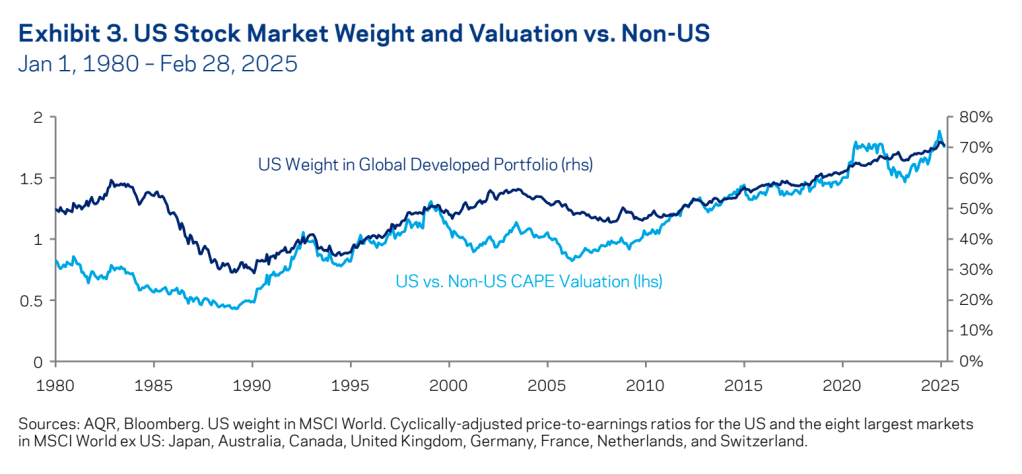
I am personally very interested that last one. Knowing that investment returns are a relative game, why would you choose to invest in a cap-weighted benchmark placing 72% of your invested assets in the US at a nearly all-time-high relative CAPE?
All these features coincide at the time of writing in the US vs rest of the world equity trade. Not surprisingly, then, US relative valuations reached almost twice the level of other developed markets near year-end 2024, having been at half-valuation level in 1990 and hovered near unity between 1995 and 2010. Despite record-high relative valuation, investors accepted a record-high 72% US weight in the MSCI developed markets index. [emphasis mine]
The real trouble with this world of ours is not that it is an unreasonable world, nor even that it is a reasonable one. The commonest kind of trouble is that it is nearly reasonable, but not quite. Life is not an illogicality; yet it is a trap for logicians. It looks just a little more mathematical and regular than it is; its exactitude is obvious, but its inexactitude is hidden; its wildness lies in wait.
G.K. Chesterton
Leigh Drogen, of Starkiller Capital, is a smart prognosticator, willing to call it as he sees it and cut against the grain, which is why the his recent letter, “Blockspace: Crypto’s Heaviest Bag, ” is so dense and compelling.
We are big long term believers in DeFi, tokenization of real world assets, gaming, DePin, enabling AI agents to transact on-chain, amongst other use cases we can think of, what we are most excited about are all the use cases we can’t yet think of. When you give entrepreneurs cheap abundant blockspace on public permissionless blockchains that have the ability to reach everyone on earth, it is inevitable that they will build some incredible and incredibly valuable things used by hundreds of millions if not billions of people.
https://www.starkiller.capital/post/blockspace-crypto-s-heaviest-bag
I pull-quoted the most optimistic part of the post, but the other compelling ideas here are:
The content from Starkiller is always original and worth reading, I strongly recommend subscribing to the Starkiller Capital Insights newsletter (just scroll to the bottom of the linked post here).
It’s supposed to be difficult. Is the difficulty leading towards what you seek?
What we get out of life is not determined by the good feelings we desire, but by what bad feelings we’re willing and able to sustain to get us to those good feelings.

