Twitter bye-bye

I would not have believed so much damage could be done in so little time.

Several years ago, I left Facebook and deleted all of my history on the site. That departure was the results of years of poor interactions and/or discoveries, largely from people I know. Deleting my profile and removing myself forever has been a positive experience.

Twitter, on the other hand, is something I have lovingly curated and really enjoyed until very recently. It’s a beautiful hub for the finance industry, in particular, and I have lists of important people that I read for investment and business insights. Not anymore. I removed the app on my phone and tablet. I removed the Twitter link from my business’s website. I’m not deleting my accounts because I think there’s still hope, and I don’t want my Twitter handles to go to any poachers, but I’m done for a while.

It’s clear that Elon has no idea how to manage a social site. Not content to leave well enough and learn, he’s been dedicated to rapidly (sometimes intra-day) implementation of diametrically opposed policies. The policies only make sense when you realize Elon’s creating permissions for people he agrees with and removing permissions for people who disagree with him. Elon’s policy is that “the policy is what I say it is.”

I hope to be back when things stabilize. Until then, I’m going to explore all other alternatives and watch where the smart folks land.

The Trouble With Goals

Goals are binary. They create an expectation, not just of completion, but of reward. Rarely do these align with anticipation.

Instead, goals are for focusing your now. This moment.

If you can learn from this moment and realign to fit your learnings, you’ll end up somewhere unexpected, but usually far better than where you were trying to go.

Jony Ive’s first project at LoveFrom ◙

From Fast Company:

I didn’t see this when it was announced last year, but the logo and typeface for an environmental project “spearheaded by Prince Charles” is absolutely lovely in every way and miles apart from the sleek industrial look that Ive is famous for.

To design LoveFrom Serif, Ive’s team studied original Baskerville punches and matrices. They analyzed the shapes and cleaned them up into digital characters. From there, the team began making Baskerville their own, adding details inspired by other lettering work of the era.

https://www.fastcompany.com/90693444/jony-ives-first-major-design-since-leaving-apple-isnt-what-youd-expect

I’m excited to see what Ive and his new company do next!

The Download: Ukraine claims it’s using facial recognition to identify dead Russian soldiers ◙

Mykhailo Fedorov, vice prime minister of Ukraine and minister of digital transformation, confirmed that Ukraine was using facial recognition software to find the social media accounts of deceased Russian soldiers, allowing authorities to contact their friends and families. The aim is to dispel misinformation surrounding the war in the country, and specifically Russian claims that it is just a special operation with few losses, he wrote on his Telegram channel.

https://www.technologyreview.com/2022/03/24/1048268/the-download-ukraine-claims-its-using-facial-recognition-to-identify-dead-russian-soldiers/

Yeesh. A new tool in psychological warfare: snuff shots sent to family members. Russian media may not produce real coverage of their unjust war (and is only reporting 498 deaths so far) but you can bet that Ukraine informing families via social media of their missing lived ones will not be easily swept under the rug. NATO estimates “40,000 Russian troops killed, wounded, taken prisoner, or gone missing.”

There are other ways of doing things…

I loved this Nilay Patel interview of Matt Mullenweg, CEO of Automattic (and thereby WordPress, Tumblr, and WooCommerce; as well as the maker of high quality apps like Simplenote, Pocket Casts, and Day One).

I had no idea how prevalent WordPress has become.

WordPress in the CMS space now has 43% of all websites. It’s growing faster than all the others combined. That will reach probably 80–85% in the next decade.

Matt Mullenweg, How WordPress and Tumblr Are Keeping the Internet Weird

43%! In the interview, Matt talks about a potential market share of 85% within the next decade. He could be wrong, but his directional velocity is probably right. That’s incredible. What’s even greater than that, in my opinion, is how he’s scaling the company ethically. You can see the responsibility he feels for monetizing the right way and empowering distributed decision-making across the entire organization.

Most of our business models are through people paying us, as opposed to advertising or other models. We provide upgrades and that recurring revenue is what allows us to come to work the next day. We’re about to come up on 2,000 people working full time with Automattic. It’s really grown a lot, even since the last time we talked. I think we hired over 700 last year.

Matt Mullenweg, How WordPress and Tumblr Are Keeping the Internet Weird

The other fun thing I like to say about Automattic is that it’s fractal. When you zoom in or out, it’s self-similar. When the entire company was 20 people, it looked a lot like what a team of 20 people looks like now. We try to make it so there’s a natural growth and division of teams.

Matt Mullenweg, How WordPress and Tumblr Are Keeping the Internet Weird

The final bit I wanted to call out and record for posterity, because it’s novel and aligns with how I think distributed companies should be run, is this bit:

I ask for transparency, so that things are written down, shared, communicated. I love the idea of decision journals. We use this internal blogging system built on WordPress called P2. […] What’s interesting at Automattic is there’s no internal email. I get a handful of emails a year from my colleagues. Everything happens on these internal blogs. What that means is we have essentially an organizational blockchain where every single decision going back to 2007 is on one of these internal blogs. You can find how every piece of code works, or every business decision, or every logo. Everything is in there somewhere.“WE HAVE ESSENTIALLY AN ORGANIZATIONAL BLOCKCHAIN WHERE EVERY SINGLE DECISION GOING BACK TO 2007 IS ON ONE OF THESE INTERNAL BLOGS.“

Even if you and I decided something in a meeting, we need to write it up afterwards. It’s on this P2, so people can participate in it asynchronously. Future generations or future versions of ourselves who’ve forgotten why we made a decision can tell why we did that.

Matt Mullenweg, How WordPress and Tumblr Are Keeping the Internet Weird

Nothing is done until it is written up and recorded. This has always been an aspirational goal of mine, even when it is out of alignment with how my employers worked. Now that I run my own company, though, I get to do it how I want.


Staying the course can be the “best idea”

Your best ideas should be somewhat durable. When I first read David Heinemeier Hansson’s “Work on your best idea” post, it felt like a clarion call to get off my ass and do something new. Surely there must be a large gap between where you need to be, today, and where you are? Right? Wrong. While not every day provides the Bacchanalian pleasures I dream about, they are situated within a risk/reward framework that I have created for myself. I have made commitments for my family, my employer, and my friends. While many of those commitments are mundane and repetitive, they are constraints I gladly accept. Sometimes the truly valuable work is a continuation of what you’re doing, and while it’s not sexy to say it that way, I think that’s a valid interpretation of the post too.

Weekend Provocations

Kevin Kelly is a god-damned treasure: I started highlighting my favorites and the whole page was going yellow.

Separate the processes of creation from improving. You can’t write and edit, or sculpt and polish, or make and analyze at the same time. If you do, the editor stops the creator. While you invent, don’t select. While you sketch, don’t inspect. While you write the first draft, don’t reflect. At the start, the creator mind must be unleashed from judgement.

Kevin Kelly, 68 bits of Unsolicited Advice

COVID-19 – the return of Wave 1: It appears nearly certain that the US is opening back up for business without heeding the guidance from leading scientists at the CDC. I’m trying to figure out what that will likely mean for my family and business, but I expect it’s not a positive…

Organized crime in antiquities: It’s shocking to me that a criminal enterprise of this scale, trading in rare and precious artifacts, can be disrupted with 19,000 archeological artifacts recovered. How long have these networks been in place and how many artifacts have they stolen from the enjoyment of broader society?

Bitcoin buffoons: The worst part about investing in Bitcoin (I have a small position) is being lumped in with the rest of the Bitcoiners. Do a search on Twitter for Bitcoin and sample the livestream of poorly reasoned (and frequently poorly spelled) drivel that is there. I’m hopeful that the silent major holders are a more cerebral lot. 

“Happy thoughts” recommendation: If you’d like a little creative multi-media inspiration each week, I enjoy Austin Kleon’s newsletter (sign up here). He’s frequently a twisty trip down random memory lane.

Weekly Recommendation Roundup – Things that make you go, hmmm

Books

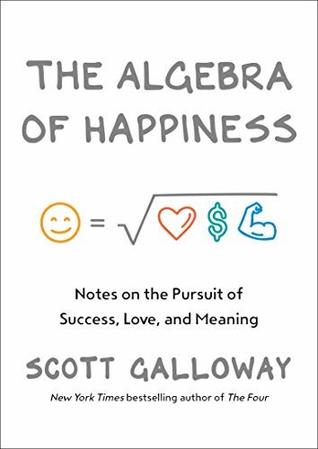
Algebra of Happiness, by Scott Galloway

This is the type of book we should all strive to write and leave to our children, it’s a highly personal distillation of Galloway’s life experiences for his students at NYU (and more importantly, his own children). If you do not like his self-absorbed presentation in his other mediums, you probably won’t like this either, but I find Scott entertaining, pithy, and refreshing in his directness. Chock full of things I wish I knew when I was 20.

Web

The Case for First-Brain Memory, by Tasshin

This post is a refreshingly through investigation of when it makes sense to memorize something, and when it doesn’t. I was blown away watching LeBron James recall a particular a series of plays after a game. It goes to show you that world-class athleticism is never purely physical.

Podcasts

The Portal: 3: Werner Herzog

The Portal is one of my new favorites for in-depth long-form interviews with people that have truly unique viewpoints on the world. The first three episodes all contain dangerous thoughts and mental models, but this one with Werner Herzog sparked my curiosity so much that I paid a transcription service to provide me the text. I knew very little about Werner Herzog prior to this interview, but he’s clearly one of the most creative forces in film. To hear him describe the challenges that he and his artists endure is a testament to uncompromising vision.

I first became aware of Werner Herzog when I was 16 and just entering the University of Pennsylvania and a friend of mine said, ‘You’ve got to see this movie, Fitzcarraldo.’

‘I said, what is Fitzcarraldo?’

He says, ‘if nothing else, it’s a story about a man so possessed by an idée fixe, that he drags a boat over a mountain in the jungle in order to somehow build an opera house.’ The whole thing sounded incredibly mad, and in fact, what was so interesting about this film was that the director actually had to do, in real life, with the crazy fictional character did inside of the story line.

Eric Weinstein

Movie

Fitzcarraldo, by Werner Herzog

You can’t listen to the podcast recommended above and NOT immediately want to go see this movie. The imagery and vision are haunting me weeks later—as do the ethical questions that the making of the money engender. I’m definitely going to be following up with the “making of” film.

Quote I’m thinking about…