The end of an era. Good-bye Evernote.

There is no paid software I have used longer than Evernote, ever. My user ID is 15,325 (they told me that 5 years in (in 2013) when they had passed 65,000,000 users). I’ve even been through the training program to become an Evernote Expert, providing consultation experiences to other people and providing feedback on new product development.

And yet, I have decided to let it lapse. As of 2 days from now, my professional account will go away, and I will move fully onto Obsidian (and will continue my exploration of Craft).

So what’s going on? Well, honestly, my refinement of my own systems and the overlap of other products, has steadily eaten away at the unique values that used to be provided by Evernote. I have great (and non-proprietary) task management and notes that can sync across my devices, and I don’t need a paid subscription of $130/yr to $170/yr to do that. To be frank, I’d probably pay up to ~$5/month for Evernote, just to have it around, but the higher price-point forced me to scrutinize what I was actually getting out of the product, which, as of late, has not been very much.

I also just want a fresh start. I have tried everything with Evernote through the years, accumulating 10,333 notes. That’s…a lot. I used the Obsidian importer to grab all of those (minus a couple dozen errors), convert them to Markdown, and make them available in a separate folder in Obsidian. They’re there if I need them and my notes will not be trapped in a proprietary .enex file (although I did store compressed version of all of those notebooks in case I ever regret my decision).

I do want to say that the Evernote application has done nothing but improve since Bending Spoons bought the company. It’s faster, more focused, and reliable.

It’s just no longer for me.

I wish them all the best.

“Exceptional Expectations: U.S. vs. Non-U.S. Equities” – Research from AQR

Part 2 of a multi-part research series from AQR: “Understanding Return Expectations” (downloadable at bottom of post with my highlights).

The research here focuses on the prolonged period of market outperformance of the US relative to non-US over the last 35 years, and makes the case that this is largely reflective of “richening relative valuations,” rather than solely being attributable to the underlying businesses.

Using AQR’s capital market assumptions as of December 2024, we calculate a growth edge of 2.2% p.a. for US equities to earn the same return as Non-US equities hedged to USD.

p.9

We suspect that few investors appreciate how much of the past absolute and relative performance reflects repricing, which really should not be extrapolated—especially when today’s extreme valuations point the other way.

p.9

Exchange Fund + 351 Exchange – Cache and Alpha Architect create a new product category

Let’s talk about the largest problems with legacy exchange funds:

  1. Exchange fund offerings are typically oversubscribed for tech workers. There just isn’t enough room an SP500 tracking exchange fund for large holders of $AMZN, $META, $NVDA, etc.
  2. If you do get your shares placed, at the end of 7 years when you “could” pull out of the exchange fund, the portfolio manager will provide you with their choice of stocks (all with your initial cost basis). You no longer have a concentrated single position, but you are left with stocks that could exhibit high tracking error when compared to the benchmark.

The 351 conversion mechanism now being offered by Cache solves these issues. From my understanding, Cache can literally allow any shares into the fund. They do not have to hand-create a portfolio from subscribers. All subscribers get converted into an ETF via 351.

At the end of 7 years, you can receive shares of the ETF out of the exchange fund. Since it is an ETF, your shares will better reflect the becnhmark you diversified into.

Brilliant.

“How Do Investors Form Long-Run Return Expectations?” – Research from AQR

Part 1 of a multi-part research series from AQR: “Understanding Return Expectations” (downloadable at bottom of post with my highlights).

The key concept in this paper is that individual investors tend to extrapolate heavily from recent market results, while institutional traders and capital market assumptions tend to be more “rationally anchored and contrarian.”

Investors may be losing faith in [capital market assumptions] and going all-in with the rearview-mirror mindset just when there appears to be dangerous bumps in the road ahead.

Forward-looking assessments, while imperfect, do have some positive predictive value have positive correlation of .52. Review-mirror approaches, on the other hand, are inversely correlated -.37.

The paper also discusses why individual investors might be pre-disposed to subject rearview-mirror thinking, based on Kahneman’s fast vs. slow thinking framework: “[…] past performance comes easily to mind, while required discount rates need more effortful thinking.”

The paper calls out the following 3 reasons to avoid rearview predictions in 2025:

  1. A too-positive directional view of risky and private assets
  2. A too-negative view on various diversifying alternatives
  3. A too-positive relative view on US equity market exceptionalism

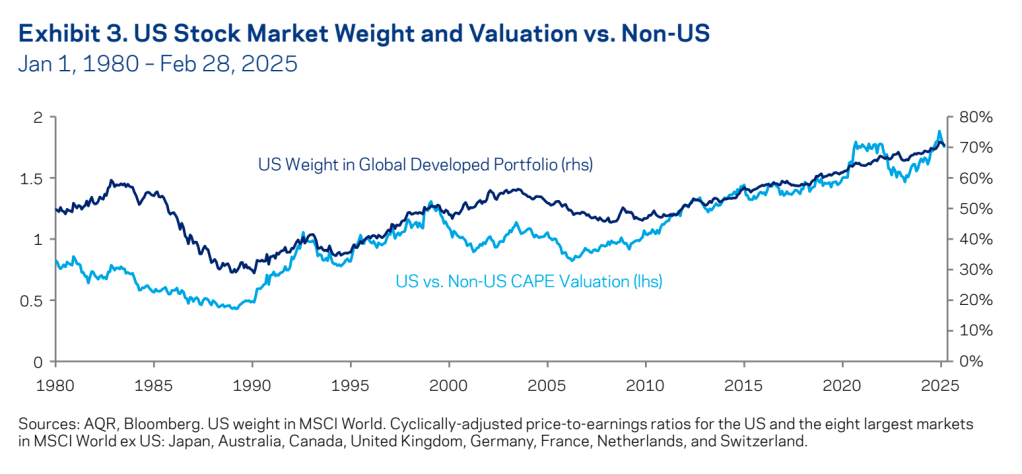
I am personally very interested that last one. Knowing that investment returns are a relative game, why would you choose to invest in a cap-weighted benchmark placing 72% of your invested assets in the US at a nearly all-time-high relative CAPE?

All these features coincide at the time of writing in the US vs rest of the world equity trade. Not surprisingly, then, US relative valuations reached almost twice the level of other developed markets near year-end 2024, having been at half-valuation level in 1990 and hovered near unity between 1995 and 2010. Despite record-high relative valuation, investors accepted a record-high 72% US weight in the MSCI developed markets index. [emphasis mine]

The real trouble with this world of ours is not that it is an unreasonable world, nor even that it is a reasonable one. The commonest kind of trouble is that it is nearly reasonable, but not quite. Life is not an illogicality; yet it is a trap for logicians. It looks just a little more mathematical and regular than it is; its exactitude is obvious, but its inexactitude is hidden; its wildness lies in wait.

G.K. Chesterton

Starkiller Capital says the era of the fat app is coming

Leigh Drogen, of Starkiller Capital, is a smart prognosticator, willing to call it as he sees it and cut against the grain, which is why the his recent letter, “Blockspace: Crypto’s Heaviest Bag, ” is so dense and compelling.

We are big long term believers in DeFi, tokenization of real world assets, gaming, DePin, enabling AI agents to transact on-chain, amongst other use cases we can think of, what we are most excited about are all the use cases we can’t yet think of. When you give entrepreneurs cheap abundant blockspace on public permissionless blockchains that have the ability to reach everyone on earth, it is inevitable that they will build some incredible and incredibly valuable things used by hundreds of millions if not billions of people.

https://www.starkiller.capital/post/blockspace-crypto-s-heaviest-bag

I pull-quoted the most optimistic part of the post, but the other compelling ideas here are:

  • Bitcoin has consolidated its permission as a store of value with some begrudging world acceptance but it has largely ceded the protocol fight to other L1’s. It’s not clear if any Bitcoin L2 will become large.
  • Ethereum might end up as a major platform for the era of fat app Starkiller Capital sees as coming, but the transaction space is so cheap, it’s a big question mark on how it will translate to Ethereum as an investment.
  • We are in the midst of a phase one meltdown (and well on our way to the “Web2 era for crypto”), as VC’s extract the easy capital in inflated L1’s of ghost town protocols. Hello, Cardano!
  • While people haven’t been paying attention, blockspace is now efficient and readily available. The apps that are coming to take advantage of are likely 6-9 months out (in the authors’ view).
    • “The stark divide between the success of ETH as an asset and the success of the Ethereum ecosystem as a technology is nothing short of epic. The chasm is so wide that many longtime developers and holders of ecosystem assets have very publicly questioned whether transacting in the ecosystem is now too cheap!”
  • Stablecoins are here and working well, likely to become way more prominent and cut banking inefficiencies…eventually.
  • And uh, the guys at Starkiller don’t like Gensler very much!

The content from Starkiller is always original and worth reading, I strongly recommend subscribing to the Starkiller Capital Insights newsletter (just scroll to the bottom of the linked post here).

Pointers

Pointers are those things that help you figure out where you should go. For this site, they’re a collection of resonant resources I have found. The point is to have them someplace when you’re seeking direction. If two pointers conflict, you decide how you weigh and calibrate between them, deciding which direction you want them to take you (or striking off on your own).

Like life experience, they accrete over time. The next one is always “coming soon.”

Incentives

On June 10, there was a bomb and gun threat at Roosevelt High School here locally in North Seattle. I don’t know much about it, but the folks at my gym were talking about it and saying it was called in from somebody within the school.

I joked about it being finals week (which, it was).

Andy, one of the trainer/owners of the gym then told us a story about the school he went to in the early 2000’s. He went to an American school in a foreign country (I don’t know which). There were 3 total bomb threats called in over a couple of weeks. This being just after September 11, the threats were taken seriously and the kids were evacuated and sent home each time.

The third time, however, the school required all the students to make-up the missed class on a Saturday.

No more bomb threats.

And that’s how incentives work.

“You Might Be a Late Bloomer,” by David Brooks

I enjoyed this piece in The Atlantic by David Brooks. The idea that there is a whole class of people, who view their life as iterated experiments, may show lower success early in life, but do their life’s work as a “second act,” has great appeal to me, as that feels like the path I am on.

Finally, there are the people Galenson calls “the masters.” In his book
Old Masters and Young Geniuses
, he writes about people like Cézanne or Alfred Hitchcock or Charles Darwin, who were not all that successful—and in some cases just not even very good at what they did—when they were young. This could have been discouraging, but they just kept improving.
These people don’t do as much advanced planning as the conceptual geniuses, but they regard their entire lives as experiments. They try something and learn, and then they try something else and learn more. Their focus is not on their finished work, which they often toss away haphazardly. Their focus is on the process of learning itself: 
Am I closer to understanding, to mastering? They live their lives as a long period of trial and error, trying this and trying that, a slow process of accumulation and elaboration, so the quality of their work peaks late in life.

You Might be a Late Bloomer,” David Brooks

Another compelling line of thought in the article is that the people who earn the rewards of early success, who are rewarded extrinsically, have less opportunity to discover and develop the intrinsic motivation that the late bloomers find rewarding. “A 2009 London School of Economics study that looked at 51 corporate pay-for-performance plans found that financial incentives “can have a negative impact on overall performance.”

I once asked a group of students on their final day at their prestigious university what book had changed their life over the previous four years. A long, awkward silence followed. Finally a student said, “You have to understand, we don’t read like that. We only sample enough of each book to get through class.” These students were hurrying to be good enough to get their merit badges, but not getting deep enough into any subject to be transformed. They didn’t love the process of learning itself, which is what you need if you’re going to keep educating yourself decade after decade—which, in turn, is what you need to keep advancing when the world isn’t rewarding you with impressive grades and prizes.

Intrinsically motivated people, by contrast, are self-directed and often obsessed, burying themselves deep into some subject or task. They find learning about a subject or doing an activity to be their own reward, so they are less likely to cut corners. As Vincent van Gogh—a kind of early late bloomer, who struggled to find his way and didn’t create most of his signature works until the last two years of his life before dying at 37—wrote to his brother, “I am seeking. I am striving. I am in it with all my heart.”

You Might be a Late Bloomer,” David Brooks